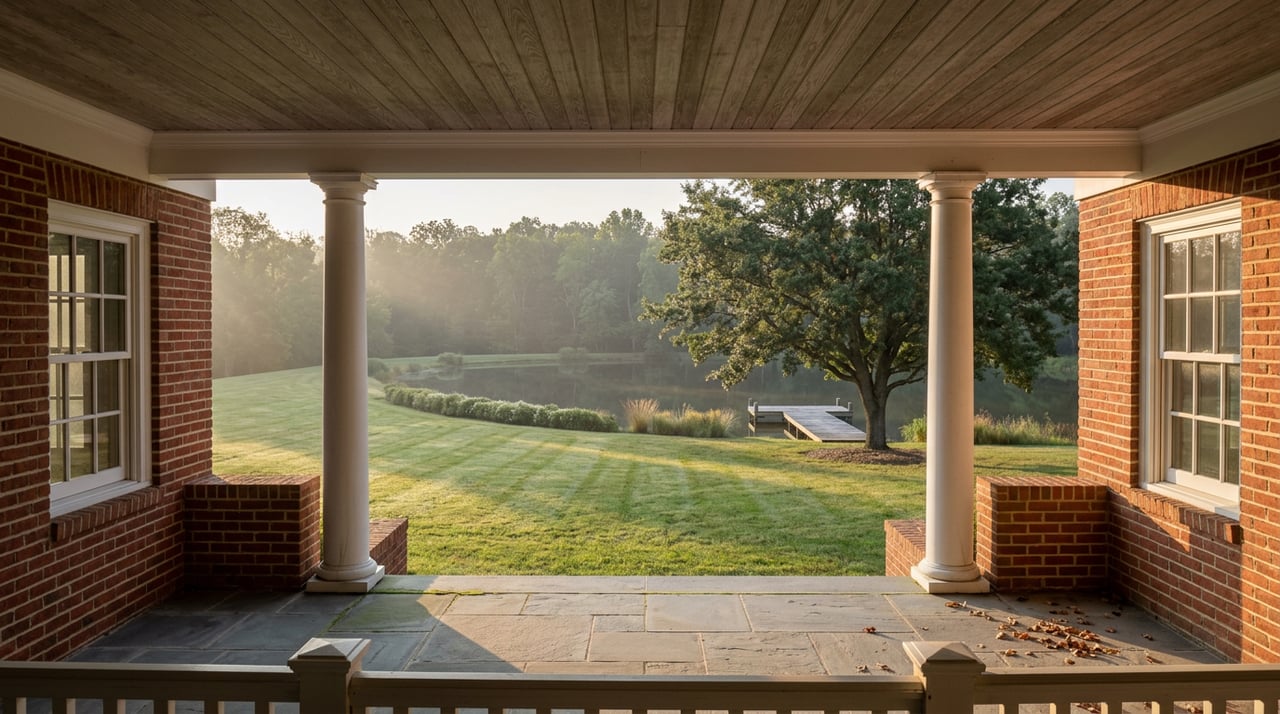
In February 2025, the owner of a 6.7-acre parcel at Birmingham and Henderson roads asked Milton for something ordinary: permission to build a new house on the property and turn the existing structure into a guest cottage. What city staff came back with was not ordinary at all. Because the land carried a tree buffer along the road frontage, open pastureland, and a working riding area with animals still on it, staff recommended something most sellers never see coming: a permanent conservation easement, in exchange for a certificate the owner could sell, not to a neighbor, but to a developer working on the opposite side of the city.
That certificate is called a transfer of development right, or TDR, and it is a large part of why so much of Milton's acreage still looks the way it did twenty years ago. Not the one-acre zoning minimum everyone quotes. The zoning sets a floor. The TDR market sets a price for staying above it, and that price is about to become a live question because of a vote the city took up this month.
The Right to Not Build Has a Price
Milton's Community Development Department runs a program that lets the owner of a qualifying parcel permanently waive the right to develop the land and sell that right to someone else entirely. The land stays in the owner's name. What changes hands is the density: the number of homes that parcel could theoretically have supported disappears from that address and reappears wherever the city wants more of it.
To qualify as what the city calls a sending site, a property generally needs at least five acres, zoning of AG-1 outside the Crabapple district or T2 inside it, and the kind of natural or agricultural features, tree cover, pasture, a riding ring, that the city has decided are worth preserving. The Birmingham and Henderson roads parcel checked every box. Once the easement is recorded, the restriction runs with the land forever. The city does not guarantee what the certificate will ultimately be worth; finding a buyer is the owner's job, and the price is whatever a developer with a density problem is willing to pay.
Why a Deerfield Credit Beats a Crabapple One
Not every TDR trades at the same value, because the two receiving districts were not built with the same exchange rate.
In Crabapple's T-4 zone, a developer can place five housing units on a one-acre site without buying anything. Buy two TDR certificates and that same acre can hold nine units, the code maximum. Deerfield's form-based code is more generous to the certificate holder: a single TDR there unlocks four bonus units instead of two, and Deerfield has a zone Crabapple lacks entirely, T-6, where a baseline density of twelve units per acre can climb to thirty-six with enough certificates in hand. A landowner selling rural acreage into Deerfield's zoning is effectively selling into a district built to pay more per certificate for the same acre of pasture.
That gap is part of why the city's next move reaches well past the aging office space still sitting underused along Deerfield Parkway.
The City Just Built the Buyer
For years, Deerfield's transformation depended on individual developers finding their own reasons to redevelop. That began to change in February, when the City Council approved a use permit for what became the first project completed under the city's Destination Deerfield framework: a roughly 25-acre redevelopment of the former Deerfield Corporate Center at the crossroads of Morris Road, Webb Road, and Deerfield Parkway. Rather than demolish the site, the developer, B Developments, kept the two existing office towers and wrapped a new street grid around them, adding roughly 24,840 square feet of ground-floor retail and restaurant space alongside new residences.
One project does not remake a 320-acre district on its own. So on August 3, staff and council spent an evening on something bigger: whether Milton should activate its own Deerfield-Focused Development Authority, a state-created entity that under Georgia law cannot transact business until the governing body formally declares a need for it to function. No vote happened that night. Deputy Public Works Director Tracie Wildes told the council that years of public engagement had produced a clear, community-driven vision for the district and that a dedicated authority could be the tool to carry it out.
Two weeks later, on August 17, a resolution to formally initiate that activation was on the council's agenda for a vote. Passing it does not finish the job. The city would still need to appoint board members, let the authority convene, give it a working name, and set it loose. But it is the step that turns a planning document into an entity with the power to issue bonds, offer incentives, and go looking for the next 13010 Morris Road.
The council's own numbers explain the urgency. Milton's commercial tax base sits at roughly 10 percent, lower than several neighboring cities, a point Councilmember Doug Hene raised during a Deerfield planning session last year. Staff used nearby examples for scale at that same meeting: Alpharetta City Center runs close to 70 percent residential to 30 percent commercial, Halcyon is similar near its core, and Avalon splits closer to 50-50. More recently, during a July 2026 Comprehensive Plan Update discussion, Councilmember Jan Jacobus put the stakes plainly, asking what it would take "to truly make the vision of Destination Deerfield happen." Wherever Deerfield eventually lands on that residential-commercial spectrum will decide how much new density the district actually needs, and every added unit of that density is a unit a developer might buy from a horse farm instead of fighting for through rezoning.
What This Changes If You Own Acreage, or Want To
If you hold five or more acres in Milton's AG-1 districts, the TDR program is not a hypothetical. It is a second asset sitting on your deed that most buyers, and some sellers, never price separately from the house and land. The decision to sell those rights is permanent, and it belongs in a pre-listing conversation, not a last-minute one raised after an appraisal comes back lower than expected.
If you are buying or developing inside Deerfield's receiving zones, the density math above is your real budget line. A project that pencils at baseline density might not pencil at code maximum once certificate costs are added, and those costs have had little reason to move in years of scattered, developer-by-developer activity. A funded authority actively working to assemble parcels changes that calculus.
If you are relocating and weighing Milton's rural north against a faster-growing alternative, the honest answer to whether that rural character holds is not a matter of political promises. It rests on whether the market underneath it keeps clearing. In Crabapple, and now in Deerfield, it has been clearing for more than a decade.
A Short FAQ
Does putting a TDR easement on my land help or hurt its resale value? It depends on what the next buyer wants. The easement forecloses future subdivision, which can matter less to someone who wants exactly the acreage and privacy you already have, and more to a buyer hoping to develop later. Either way, it is a decision to make with full information before you list, not after an offer arrives.
Can I still sell my house normally once the TDR rights are gone? Yes. The house, the barn, and the land transfer as they always would. What has left the property is the unused density it once carried, and by then that density belongs to a different address entirely.
Does the new Development Authority build anything itself? Not directly. Its tools are financial, bonds and incentives that help a private developer's numbers work. The building still happens through applications like the one that produced the redevelopment at 13010 Morris Road.
Milton priced its own rural character years before Deerfield's cranes arrived to test that number. Whether you are sitting on acreage you have never thought to value this way, or comparing Milton's staying power against a faster-growing suburb, that price is worth understanding before you sign anything. Andrea Seeney works through exactly these questions with landowners, sellers, and buyers across Milton and North Fulton. Request a Confidential Consultation to talk through what your parcel, or your search, actually stands on.