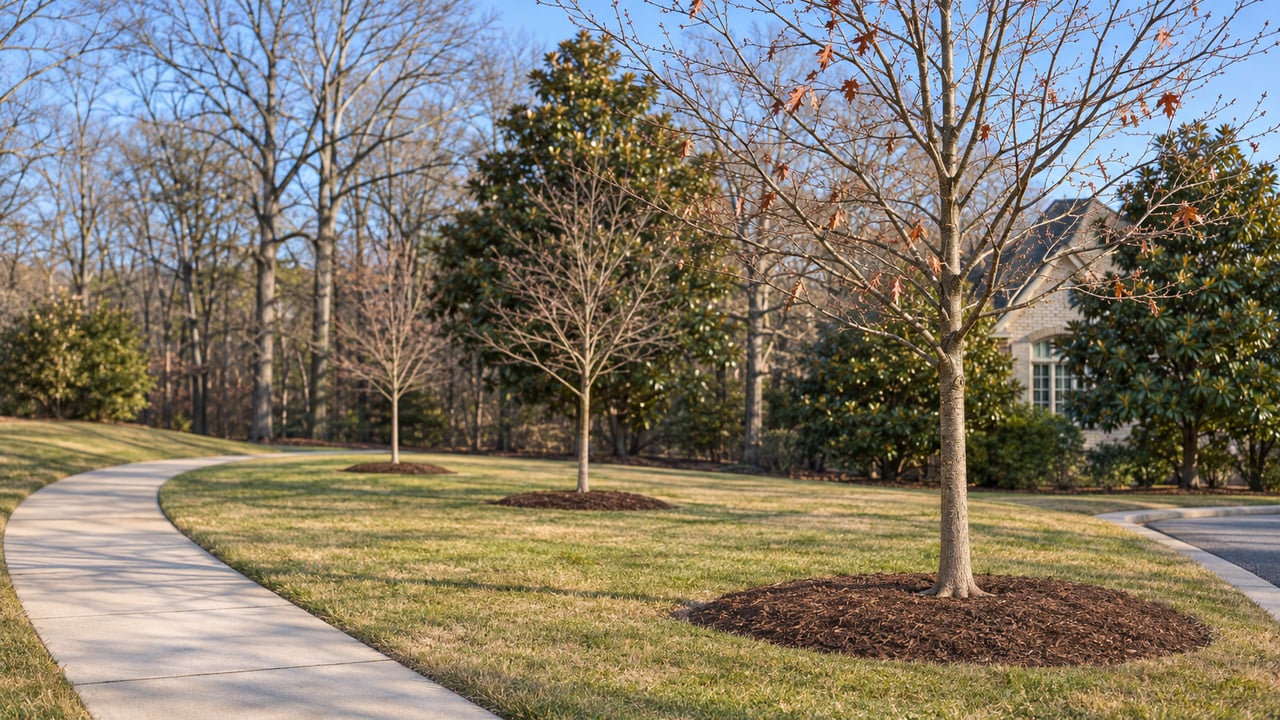
Why would a city plant more than 500 trees along two of its busiest roads in late fall, and then wait until spring for the shrubs? On Nov. 9, the Alpharetta City Council answered that with a schedule. It approved a contract with Russell Landscape to plant 260 trees along State Route 9, or North Main Street, from Cumming Street north to Windward Parkway. The same contract covers 271 trees along Phase 2B of the Webb Bridge Road corridor improvements. The planting window opened this month and runs through February 2027. The city expects installation to be complete by Feb. 28.
These trees are the first planned layer of two streetscapes that drivers on North Main and Webb Bridge have watched under construction for years. Each road has its own budget, its own planting list and its own amount of underground root barrier. The order of the work, trees in winter and shrubs later, comes straight from what makes each kind of plant survive.
Two corridors, two separate budgets
The contract caps the total at $1,296,535.09. That total is really two projects billed together, each paid for from its own account.
| Webb Bridge Road, Phase 2B | SR 9 / North Main Street | |
|---|---|---|
| Trees | 271 | 260 |
| Average trunk diameter | 3 inches | 3 inches |
| Root barrier | 6,900 linear feet | 11,440 linear feet |
| Watering | Years one and two | Years one and two |
| Cost | $637,777.27 | $658,757.82 |
| Funding account | Tree Replacement Fund | SR 9 Landscaping |
The Webb Bridge cost matches the Tree Replacement Fund appropriation to the cent, and the SR 9 cost matches the SR 9 Landscaping account the same way. The staff report lists no outside funding for either corridor. Divide each budget by its tree count and you get about $2,350 per tree on Webb Bridge and about $2,530 per tree on North Main. Those figures cover the tree, installation, root barrier and two years of watering.
The root barrier is the bigger difference. North Main gets 11,440 feet of it for 260 trees, roughly 44 feet per tree. Webb Bridge gets 6,900 feet for 271 trees, about 25 feet per tree. The city's stated purpose for the barrier is to keep roots from damaging the concrete sidewalk and curb. In practice, that means the sidewalks being finished on these corridors now are being protected from the trees planted next to them.
What's going in on North Main Street
The SR 9 planting schedule lists ten varieties, sometimes down to the cultivar name. The largest groups are oaks and tulip poplars:
- 56 Milliken overcup oak
- 52 'Emerald City' tulip poplar, 10 at 2.5-inch caliper and 42 at 3-inch
- 28 Alta southern magnolia
- 28 Shawnee Brave bald cypress, 19 at 2.5-inch caliper and 9 at 3-inch
- 24 Phoenix Spire dawn redwood
- 20 'Creole Queen' American elm
- 18 'Sun Breaker' swamp white oak
- 12 Green Whisper bald cypress
- 12 Nuttall oak
- 10 Nellie R. Stevens holly
Oaks of three kinds make up 86 of the 260 trees. Add the tulip poplars, elms, dawn redwoods and bald cypresses, and most of North Main's new planting is shade and canopy trees. Holly is a small share, at 10 trees.
What's going in on Webb Bridge Road
Webb Bridge's schedule has twelve varieties and leans the other way:
- 42 Nellie R. Stevens holly
- 36 Taylor eastern red cedar
- 35 'Green Pillar' pin oak
- 33 'Green Shadow' sweetbay magnolia
- 28 'Aiken Red' American holly
- 18 'Colonial Spirit' American elm
- 18 'Green Spring' overcup oak
- 17 'Emerald City' tulip poplar
- 14 'Green Whisper' bald cypress
- 12 'Prairie Sentinel' pond cypress
- 12 Nuttall oak
- 6 Regal Prince oak
Hollies and red cedar account for 106 of Webb Bridge's 271 trees, against 10 hollies on North Main. Two corridors under the same contract were planned as two different streets.
The city explained its choices in the staff report. Species "considered site conditions, utility conflicts, and performance data from similar City projects." All nursery stock must meet the American Standard for Nursery Stock, ANSI Z60.1-2014. Russell Landscape and Public Works also worked together to find tree farms in the area that could supply enough trees for both corridors.
Why the trees come now and the shrubs come later
The timing follows the plants. The contract covers trees only. The city expects a separate cost proposal for shrubs along both corridors in early 2027. Staff explained the split this way: "Trees have a higher survivability rate if they are planted in the winter and shrubs have a greater survivability rate when planted near or after the last anticipated frost date for our area." The landscape plan notes set the tree planting period as Nov. 1 through Feb. 28.
That puts the streetscape on a clear schedule through 2027:
- November 2026 through Feb. 28, 2027: trees go into the prepared landscape areas on both corridors.
- Early 2027: the city receives a cost proposal for shrubs along North Main and Webb Bridge.
- Around and after the last frost: shrubs are planted, which is when they survive best.
- The first two years after planting: the contract's watering requirement and the two-year tree warranty apply. Ongoing maintenance is provided under the city's existing Citywide Landscape Maintenance contract.
The warranty is the detail that lasts longest. The city's Urban Forestry Program Manager and its Urban Forestry and Landscape Specialist manage the project through installation, watering and the warranty period. The contractor has to post payment and performance bonds. The specifications set detailed watering requirements and a two-year warranty for every tree, which the city says is meant to support successful establishment.
The road work these trees finish
City staff said the tree contract became possible because landscape construction on the two road projects "has progressed sufficiently for tree installation to begin." Both projects have been on these corridors for a long time.
On North Main, Appen Media reports that the Georgia Department of Transportation has widened and rebuilt about 3.6 miles of road from Cumming Street north to Windward Parkway to improve safety and mobility for drivers and pedestrians. The work began in 2021 with a projected 2024 finish. Utility relocations, right-of-way changes and design changes pushed it back.
On Webb Bridge, the corridor improvements include a new bridge over Big Creek that replaces the vehicle and pedestrian bridges. They also include a multiuse trail from east of North Point Parkway to the Big Creek Greenway culvert, according to the same Appen Media report. That trail tie-in fits with the city's wider push to link its trail systems, covered in our posts on the Alpha Loop and the Big Creek Greenway and on the newly funded connection across GA-400.
The staff report also has a practical note for Webb Bridge. Not all utilities along that road have been relocated yet. Public Works told Georgia Power and the other utility vendors earlier this year that planting would happen in winter 2026/2027 and spring 2027. The department will monitor the relocation work, document any damage to new plantings or city infrastructure, and arrange replacements or repairs with the responsible vendor. If a new tree on Webb Bridge looks disturbed in the months ahead, the city already has a process for that.
The contract pricing includes traffic control, so expect crews and equipment along the shoulders of both roads at some point this winter.
How the council saw it
The vote was unanimous. Afterward, Councilman John Hipes called the project an "aha moment," Appen Media reported. "I just want to take a moment and pause to say this is a vote for $1.3 million of trees on the corridors to beautify our city," he said. Appen Media also reported that Hipes said he was glad to support the plantings because residents often hear about trees being removed, and added, "There is a plan in place, and it is beautiful."
Anyone who wants the full planting schedule, down to which cultivar arrives at 2.5-inch caliper, can read the Nov. 9 staff report and its contract attachment on the city's CivicClerk portal. For more on how these corridors fit into the rest of the city, see our Alpharetta neighborhood guide.
Streetscape work like this changes what a home on or near North Main Street or Webb Bridge Road looks like from the curb, and it happens in stages over the next two years. If you own along either corridor and want to know how the new plantings and finished road work could factor into the timing of a sale, Andrea Seeney offers a discreet, informed perspective. Request a Confidential Consultation.